
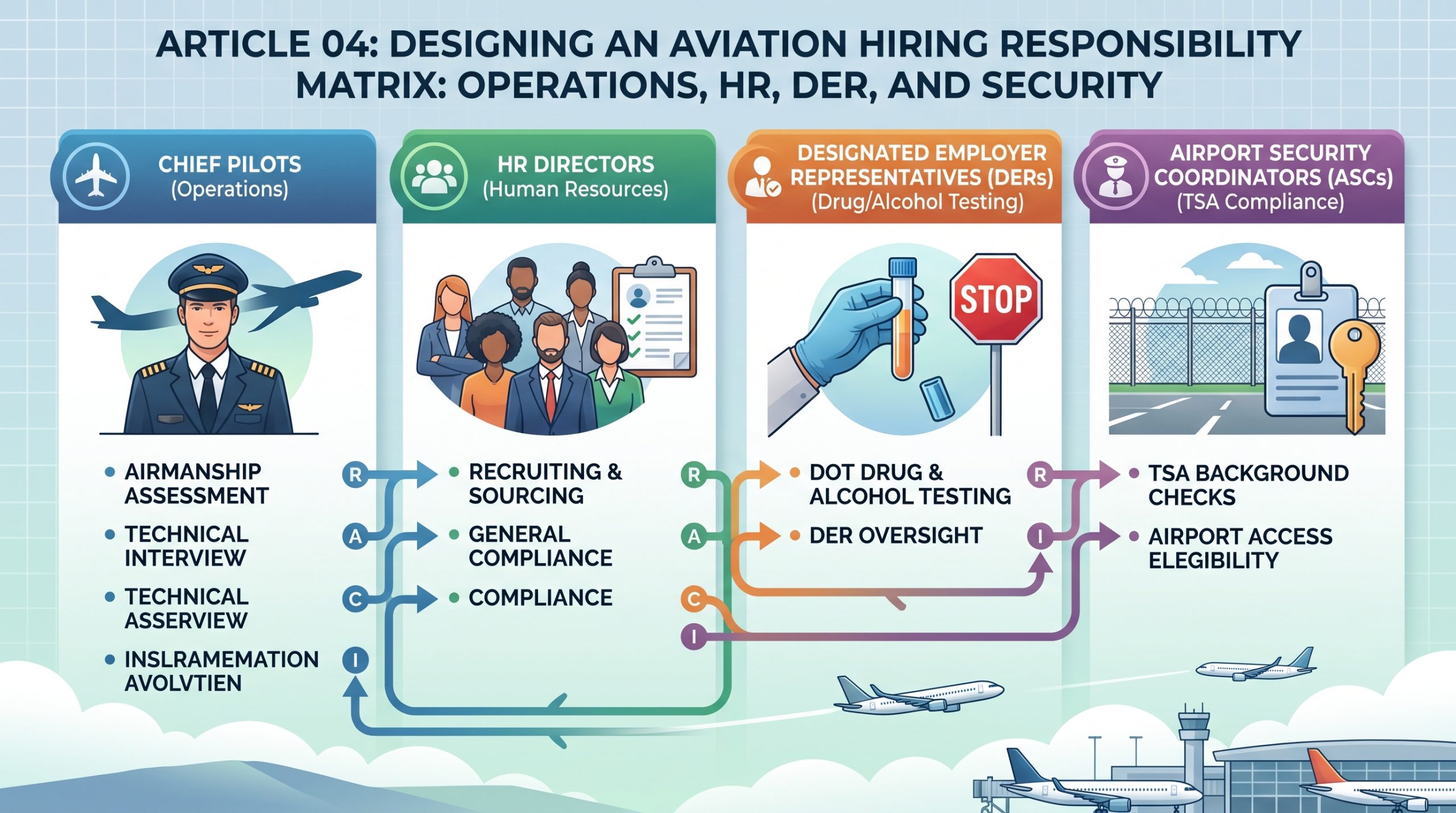
Operations, HR, DER, and Security Considerations
In commercial, charter, and business aviation flight departments, talent acquisition is an operational safety function governed by complex federal mandates. Unlike conventional corporate hiring, onboarding an airman, maintenance technician, or flight dispatcher requires navigating rigorous multi-agency regulatory frameworks. In this high-stakes environment, a single compliance oversight can compromise an Air Carrier Operating Certificate, ground an entire fleet, or expose the enterprise to catastrophic negligent hiring litigation following an incident.
When flight operations, human resources, drug testing administrators, and security coordinators operate in organizational silos, critical regulatory steps fall through the cracks. An effective aviation hiring responsibility matrix RACI establishes an unambiguous operational framework that clearly delineates who is Responsible, Accountable, Consulted, and Informed across every phase of the onboarding lifecycle. By formalizing an aviation hiring responsibility matrix RACI, aviation organizations eliminate cross-departmental confusion, ensure strict regulatory compliance, and build a defensible, safety-first talent pipeline.
Deconstructing the RACI Framework for Flight Operations
The RACI model is a structured governance tool designed to map out organizational roles and prevent ambiguity during complex workflows. Applying an aviation hiring responsibility matrix RACI ensures that every critical regulatory touchpoint—from FAA Pilot Records Database (PRD) reporting to Department of Transportation (DOT) drug screening—has clear operational ownership.
The four core designations within an aviation hiring responsibility matrix RACI are defined as follows:
- Responsible (R): The operational stakeholder who executes the task or completes the compliance action. This individual does the actual work required to achieve the deliverable.
- Accountable (A): The single decision-maker who holds ultimate veto power and enterprise liability for the correct, thorough completion of the task. Only one person can be accountable for a specific action in an aviation hiring responsibility matrix RACI.
- Consulted (C): Subject matter experts whose input, technical validation, or regulatory sign-off is required before work can be completed or a decision finalized.
- Informed (I): Key personnel who must be updated on progress, milestones, or clearance decisions, but do not contribute directly to the task execution.
RACI Governance Flow:
Responsible (Executes Task) → Consulted (Provides Expert Input) → Accountable (Final Approval & Liability) → Informed (Notified of Status)
Implementing a standardized aviation hiring responsibility matrix RACI prevents dangerous assumptions where HR assumes Flight Operations checked logbook authenticity, or Flight Operations assumes HR verified DOT drug testing clearance.
Core Stakeholders in the Aviation Hiring Responsibility Matrix Lifecycle
A comprehensive aviation hiring responsibility matrix RACI aligns four specialized organizational roles, each bringing distinct operational responsibilities and regulatory mandates.
Aviation Hiring Stakeholder Map:
- Flight Operations (Chief Pilot / Director of Operations): Technical qualifications, 14 CFR compliance, airmanship evaluation, PRD review, and operational control.
- Human Resources (HR Director / Talent Acquisition): Employment law, Title VII, ADA, FCRA disclosure compliance, wage transparency, and offer execution.
- Drug & Alcohol Compliance (Designated Employer Representative – DER): 49 CFR Part 40 compliance, DOT 5-panel screening, CCF management, and historical testing verification.
- Airport & Corporate Security (Airport Security Coordinator – ASC): TSA 49 CFR Parts 1542/1544 compliance, 10-year FBI CHRC, Security Threat Assessments (STA), and SIDA credentialing.
1. Chief Pilot / Director of Operations (Flight Operations)
Flight operations leadership holds direct accountability for operational control, airmanship, crew qualifications, and compliance with 14 CFR regulations. Under an aviation hiring responsibility matrix RACI, the Chief Pilot evaluates flight hour integrity, checks type rating currency, reviews training footprint history, and audits records retrieved from the FAA Pilot Records Database (PRD). Flight operations leadership maintains the final operational veto over any candidate.
2. HR Director / Talent Acquisition
The Human Resources Director manages employment law compliance, including Title VII of the Civil Rights Act, Equal Employment Opportunity Commission (EEOC) rules, the Americans with Disabilities Act (ADA), and the Fair Credit Reporting Act (FCRA). Within the aviation hiring responsibility matrix RACI, HR structures the conditional offer of employment, manages third-party Consumer Reporting Agency (CRA) background checks, enforces wage transparency mandates, and executes adverse action notifications when required.
3. Aviation Hiring Responsibility Matrix and the Designated Employer Representative (DER)
The Designated Employer Representative (DER) manages the mandatory workplace drug and alcohol testing program governed by 49 CFR Part 40 and 14 CFR Part 120. In an aviation hiring responsibility matrix RACI, the DER coordinates pre-employment DOT 5-panel drug testing, handles chain-of-custody documentation, communicates directly with Medical Review Officers (MROs), and verifies prior DOT employer drug and alcohol background checks.
4. Airport Security Coordinator (ASC) / Corporate Security
The Airport Security Coordinator ensures strict compliance with Transportation Security Administration (TSA) mandates under 49 CFR Parts 1542 and 1544. Embedded within the aviation hiring responsibility matrix RACI, the ASC oversees fingerprinting for 10-year FBI Criminal History Record Checks (CHRC), executes Security Threat Assessments (STA), and manages Security Identification Display Area (SIDA) badging authorizations.
The Master Aviation Hiring RACI Matrix
The following operational table outlines the complete division of oversight across the hiring lifecycle. This ready-to-implement aviation hiring responsibility matrix RACI establishes clear accountability across technical, legal, and security dimensions.
| Hiring Workflow & Compliance Step | Chief Pilot (Ops) | HR Director (HR) | DER (DOT Drug/Alcohol) | ASC (Security/TSA) |
| Requisition & Minimum Qualifications Definition | A | R | I | I |
| Technical Resume & Flight Experience Pre-Screen | A / R | C | I | I |
| Structured Technical & Airmanship Interview | A / R | C | I | I |
| Conditional Offer of Employment Execution | C | A / R | I | I |
| FAA Pilot Records Database (PRD) Record Pull | A / R | C | I | I |
| Logbook Forensic Audit & Flight Hour Verification | A / R | I | I | I |
| DOT Pre-Employment Drug Screening (49 CFR Part 40) | I | C | A / R | I |
| Prior DOT Employer Drug & Alcohol Inquiries | I | C | A / R | I |
| National Driver Register (NDR) Record Audit | A | R | C | I |
| 10-Year FBI Fingerprint-Based CHRC | I | C | I | A / R |
| TSA Security Threat Assessment (STA) & SIDA Badging | I | C | I | A / R |
| FCRA Background Check (Credit, Civil, Criminal) | I | A / R | I | I |
| Pre-Adverse & Adverse Action Execution (FCRA) | C | A / R | C | C |
| Final Operational Safety Sign-Off & Training Release | A / R | I | C | C |
Using this aviation hiring responsibility matrix RACI, organizations eliminate cross-departmental blind spots and establish verifiable audit trails for regulatory authorities.
Implementing the RACI Matrix Across the Four Hiring Phases
To execute an aviation hiring responsibility matrix RACI effectively, flight departments must structure their onboarding process into four distinct phases, ensuring that legal prerequisites are satisfied before invasive regulatory background reviews begin.
Four-Phase RACI Implementation Pipeline:
Phase 1: Technical Scoping → Phase 2: Conditional Offer → Phase 3: Multi-Agency Audit → Phase 4: Final Sign-Off
Phase 1: Pre-Offer Technical Scoping & Screening
During initial candidate evaluation, Flight Operations is Responsible and Accountable for assessing total flight time, multi-engine experience, instrument proficiency, and aircraft type ratings against company Operations Specifications (OpSpecs). HR serves in a Consulted role, ensuring job postings and initial interview rubrics adhere to EEOC guidelines and state salary disclosure mandates. Utilizing the aviation hiring responsibility matrix RACI at this phase prevents candidates who fail baseline flight requirements from progressing into administrative processing.
Phase 2: The Conditional Offer Gateway
Under the Americans with Disabilities Act (ADA) and Fair Credit Reporting Act (FCRA), detailed medical histories, formal drug screenings, and comprehensive background investigations must occur post-offer. HR is Accountable and Responsible for drafting and extending a formal conditional offer of employment. Within the aviation hiring responsibility matrix RACI, this conditional offer explicitly states that employment is contingent upon satisfactory completion of PRD audits, DOT drug testing, TSA security clearances, and FAA aeromedical validation.
Phase 3: Post-Offer Regulatory Due Diligence
Once the candidate signs the conditional offer, the operational screening pathways diverge into specialized tracks governed by the aviation hiring responsibility matrix RACI:
- Flight Operations Track: The Chief Pilot pulls complete historical data from the FAA Pilot Records Database (PRD), audits National Driver Register (NDR) reports for driving offenses, and conducts a forensic logbook inspection.
- Drug & Alcohol Compliance Track: The DER orders the DOT pre-employment drug test, tracks the chain-of-custody forms, receives the verified laboratory result from the Medical Review Officer (MRO), and requests 3-year safety-sensitive testing records from prior employers.
- Airport Security Track: The ASC submits fingerprint cards to the FBI for a 10-year Criminal History Record Check (CHRC) and initiates the TSA Security Threat Assessment for SIDA badge issuance.
- HR Employment Law Track: HR reviews non-aviation background screening elements (civil litigation records, education verification) and ensures all FCRA pre-adverse action notices are executed if disqualifying records emerge.
Maintaining an active aviation hiring responsibility matrix RACI ensures that each specialized track proceeds in parallel without administrative delays or procedural omissions.
Phase 4: Final Safety Adjudication and Onboarding Sign-Off
The final stage of the aviation hiring responsibility matrix RACI requires a formal clearance review before an employee is added to training rosters or assigned flight duties. While HR confirms employment eligibility through Form I-9 / E-Verify and the DER confirms a verified negative DOT drug result, the Chief Pilot holds sole Accountability for granting final operational safety clearance. No flight crew member enters revenue service without this unified sign-off.
Mitigating Critical Boundary Collisions and Compliance Risks
Without a clearly established aviation hiring responsibility matrix RACI, organizations frequently encounter operational and legal friction between departments. Three common boundary collisions illustrate the necessity of defined governance:
1. FCRA Disclosures vs. FAA PRD Reporting Requirements
The Fair Credit Reporting Act requires strict disclosure and dispute rights when third-party background reports yield adverse information. However, FAA 14 CFR Part 111 mandates that air carriers review pilot safety records and report safety concerns. An aviation hiring responsibility matrix RACI establishes that HR leads FCRA procedural compliance while the Chief Pilot evaluates the operational significance of historical training failures or regulatory infractions.
2. DER Medical Confidentiality vs. HR Personnel Files
Under 49 CFR Part 40, DOT drug and alcohol testing records are strictly confidential and must be maintained in dedicated, secure files separate from standard personnel records. Relying on an aviation hiring responsibility matrix RACI ensures that the DER maintains exclusive control over testing documents, preventing HR from improperly storing protected medical and substance abuse data in general employment files.
3. Security Clearances vs. Training Class Deadlines
Aviation recruitment frequently faces tight simulator schedule constraints. When training class dates approach, commercial pressure may mount to seat pilots before security reviews conclude. The aviation hiring responsibility matrix RACI empowers the ASC and Chief Pilot to enforce non-negotiable safety stop-points, prohibiting any candidate from commencing unescorted operational training until CHRC and TSA STA clearances are formally certified.
Establishing Continuous Auditing and Compliance Governance
An aviation hiring responsibility matrix RACI is not a static document; it is an active operational control system. Flight departments must implement quarterly audits to ensure that every candidate file contains complete documentation matching the matrix definitions.
Key audit checkpoints within the aviation hiring responsibility matrix RACI include:
- Verifying that all PRD queries were completed and evaluated prior to revenue flight assignments.
- Confirming that all DOT pre-employment drug tests possess verified negative MRO certifications before safety-sensitive duties commenced.
- Ensuring that TSA CHRC fingerprint results and STA approvals are fully documented in security files.
- Reviewing adverse action files to confirm that FCRA pre-adverse and final adverse notices complied with statutory waiting periods.
By maintaining rigorous internal audit standards through the aviation hiring responsibility matrix RACI, operators safeguard their organization against FAA fines, DOT consent decrees, and civil liability.
Building an Institutionalized Safety Culture
Adopting an aviation hiring responsibility matrix RACI transforms talent acquisition from a disjointed administrative chore into an institutionalized, safety-critical operational system. By dividing oversight across the Chief Pilot, HR Director, DER, and ASC, aviation operators establish ironclad regulatory compliance and robust defense against negligent hiring claims.
Implementing this structured framework guarantees that every individual operating an aircraft or maintaining flight systems has undergone exhaustive, multi-disciplinary vetting. Ultimately, an aviation hiring responsibility matrix RACI protects corporate assets, upholds regulatory integrity, and reinforces the organization’s overarching commitment to aviation safety. Utilizing an aviation hiring responsibility matrix RACI ensures that operational excellence and legal diligence remain permanently aligned across the enterprise.