
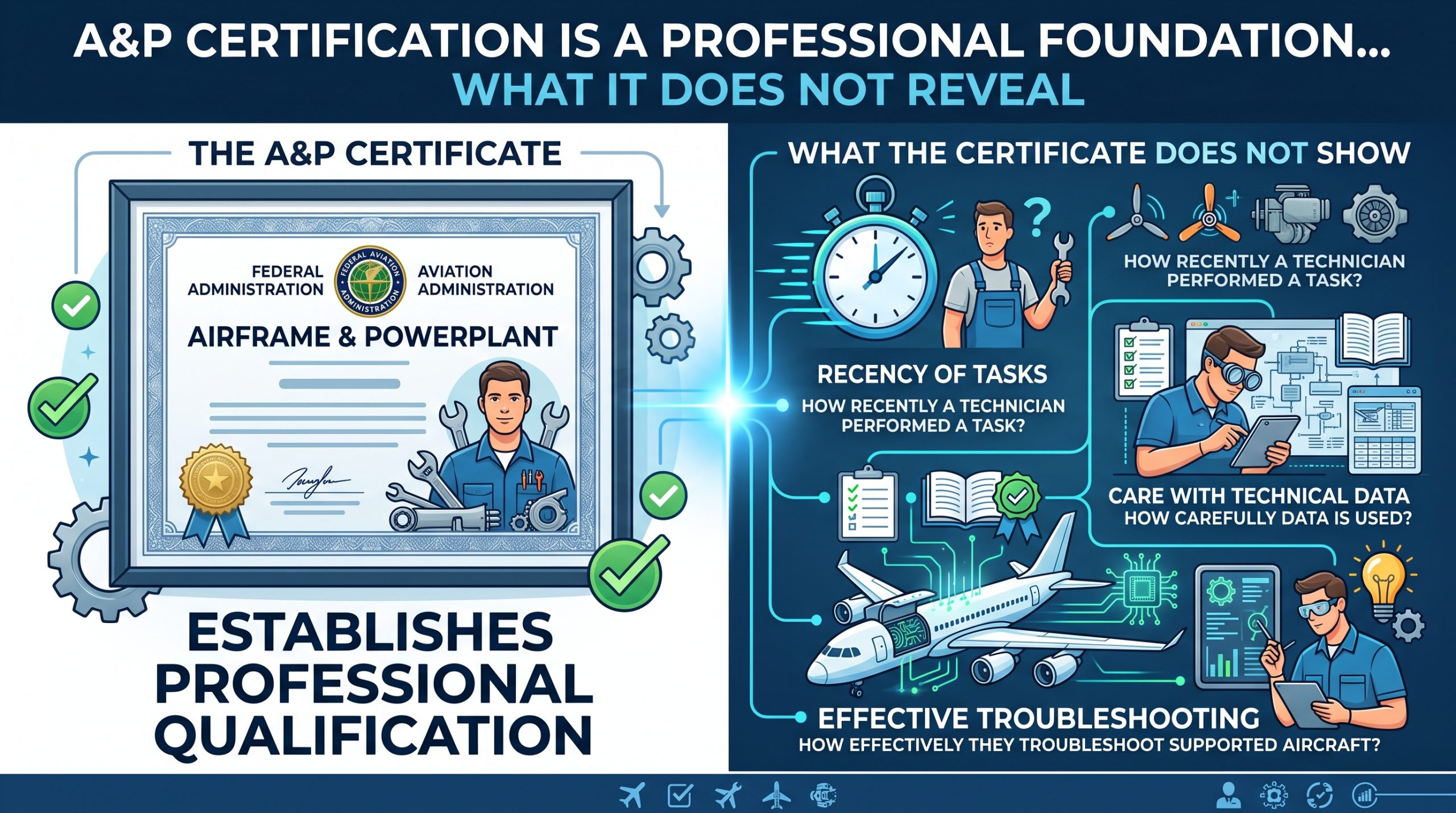
Evaluating Technician Competence
An airframe and powerplant certificate establishes an important professional qualification. It does not tell an employer how recently a technician has performed a particular task, how carefully that person uses technical data, or how effectively the person can troubleshoot a problem on the aircraft the organization supports.
An aircraft maintenance skills assessment helps close that gap. It allows an employer to evaluate how a candidate approaches maintenance work, applies approved information, recognizes risk, documents actions, and responds when the answer is not immediately obvious. The objective is not to recreate a certification test. It is to determine whether the applicant can perform the employer’s work at the level the position requires.
Start With the Maintenance Environment
Technician roles vary widely. A line maintenance position at a busy airport is not the same as a heavy-check assignment in a repair station. A field-service technician supporting rotorcraft faces different demands from an avionics specialist, an engine shop technician, or a mechanic assigned to a corporate flight department.
Before developing an aircraft maintenance skills assessment, the employer should identify the tasks the person will actually perform, the level of supervision available, the manuals and systems used, and the decisions the technician will be authorized to make. This job analysis keeps the assessment focused on competence that matters.
The standard should also match the level of the role. An entry-level technician may need to demonstrate safe work habits, correct tool use, and the ability to follow technical data. A lead technician or inspector should be evaluated on deeper troubleshooting, work control, documentation review, quality decisions, and the ability to guide others without bypassing required procedures.
What an Aircraft Maintenance Skills Assessment Should Evaluate
Use of Technical Data
One of the most revealing exercises is asking the applicant to locate and apply information from a maintenance manual, illustrated parts catalog, wiring diagram, service bulletin, or other job-relevant source. The evaluator can observe whether the technician confirms applicability, follows revisions, respects warnings and cautions, and avoids relying on memory when approved data is required.
An aircraft maintenance skills assessment should reward disciplined information use. Speed matters in many maintenance environments, but speed without control can create rework, damage, or an unsafe return to service.
Inspection and Defect Recognition
Employers can use representative components, photographs, mock-ups, or controlled aircraft access to test inspection skill. The task might involve identifying corrosion, wear, improper safetying, fluid leakage, damaged wiring, foreign-object hazards, or evidence of an earlier incorrect repair.
The important question is not merely whether the applicant finds a planted defect. The evaluator should also note the inspection method, lighting and access choices, attention to surrounding areas, and ability to distinguish an actual discrepancy from a condition that remains within limits.
Aircraft Maintenance Skills Assessments Troubleshooting Process
Troubleshooting is often where experience becomes visible. A strong technician defines the complaint, verifies the condition, studies the system, gathers evidence, and narrows possible causes before replacing parts. A weak approach jumps immediately to a familiar component or treats previous experience as proof.
A scenario-based aircraft maintenance skills assessment can present fault messages, pilot reports, maintenance history, wiring information, or test results in stages. The candidate should explain the next action and why it is justified. This allows the employer to evaluate logic without requiring an actual live fault on an aircraft.
Tools, Materials, and Workmanship
Hands-on tasks may assess tool selection, calibration awareness, torque practices, hardware identification, electrical repair, safety wire, fluid-line installation, connector handling, or other skills relevant to the opening. Employers should use controlled tasks that can be performed safely and consistently for each applicant.
The aircraft maintenance skills assessment should consider the completed work and the process used to produce it. Organization, contamination control, tool accountability, protection of adjacent components, and final inspection are part of technician competence.
Records and Maintenance Communication
Maintenance is not complete merely because the physical task is finished. Technicians must create accurate records, communicate unresolved conditions, and describe work clearly enough for others to understand what was found and accomplished.
A useful exercise may ask the applicant to review a sample discrepancy, determine whether the information is sufficient, and prepare a maintenance entry or turnover note. The goal is not to trap the candidate with formatting details unique to the employer. It is to determine whether the person understands traceability, clarity, and the significance of maintenance records.
Combine Written, Oral, and Practical Evidence
A written test can efficiently assess general knowledge, but it should not carry the entire decision. Someone may perform well on familiar questions while struggling to apply the same concepts at the aircraft. Conversely, a capable technician may need time to become comfortable with the wording of a formal exam.
A balanced aircraft maintenance skills assessment may include a short written component, a technical-data exercise, an oral troubleshooting scenario, and one or two hands-on tasks. The combination reveals more than any single method. It also allows the employer to separate knowledge gaps from communication issues or lack of recent practice.
The assessment should use the tools and references normally available for the work. Preventing applicants from consulting technical data may test memory, but maintenance organizations generally need technicians who know how to find, confirm, and correctly use authoritative information.
Build a Role-Specific Scoring Standard
Before testing begins, the employer should define how each task will be scored. Observable criteria might include correct reference selection, compliance with cautions, safe tool use, defect recognition, diagnostic logic, workmanship, documentation, and final verification.
An aircraft maintenance skills assessment should also identify critical failures. Examples may include creating an unsafe condition, intentionally ignoring required technical data, concealing an error, or demonstrating a serious lack of tool or energy-control discipline. These events should not disappear inside an otherwise acceptable average score.
Scoring anchors make evaluator judgment more consistent. A strong response, an acceptable response, and an unacceptable response should be described in advance. If multiple evaluators participate, they should review the standard together and score a sample exercise before assessing candidates.
Keep the Process Fair and Operationally Relevant
Every applicant for the same role should receive comparable instructions, time, equipment, references, and working conditions. If one candidate is coached through a task while another is left alone, the scores do not support a meaningful comparison.
The aircraft maintenance skills assessment should be accessible to qualified applicants and limited to capabilities genuinely connected to the position. Employers should avoid unnecessary physical demands, obscure trivia, or tasks that belong to a different specialty. The test should also protect proprietary data and prevent any applicant from performing unsupervised maintenance on an airworthy aircraft.
Use Results to Make Better Training Decisions
Assessment results need not lead only to a pass-or-fail hiring decision. They can identify the level of supervision a new employee will need, establish initial training priorities, or show that a candidate is better suited to another maintenance role. An experienced technician moving between aircraft families may possess strong underlying habits while needing structured differences training.
The aircraft maintenance skills assessment should help the employer distinguish a trainable lack of familiarity from a deeper problem with judgment, procedural discipline, or workmanship. That distinction protects both the organization and the applicant from a poor placement.
Competence Is Demonstrated in the Work
Certificates, employment history, and references remain essential parts of maintenance hiring. They provide evidence of eligibility and experience. They cannot show, by themselves, how a technician will approach the next discrepancy placed in front of them.
A well-designed aircraft maintenance skills assessment makes the hiring process more practical. It focuses attention on technical discipline, problem-solving, safety, documentation, and work quality. Most importantly, it gives the employer a clearer view of whether the candidate can turn qualifications into reliable maintenance performance.