
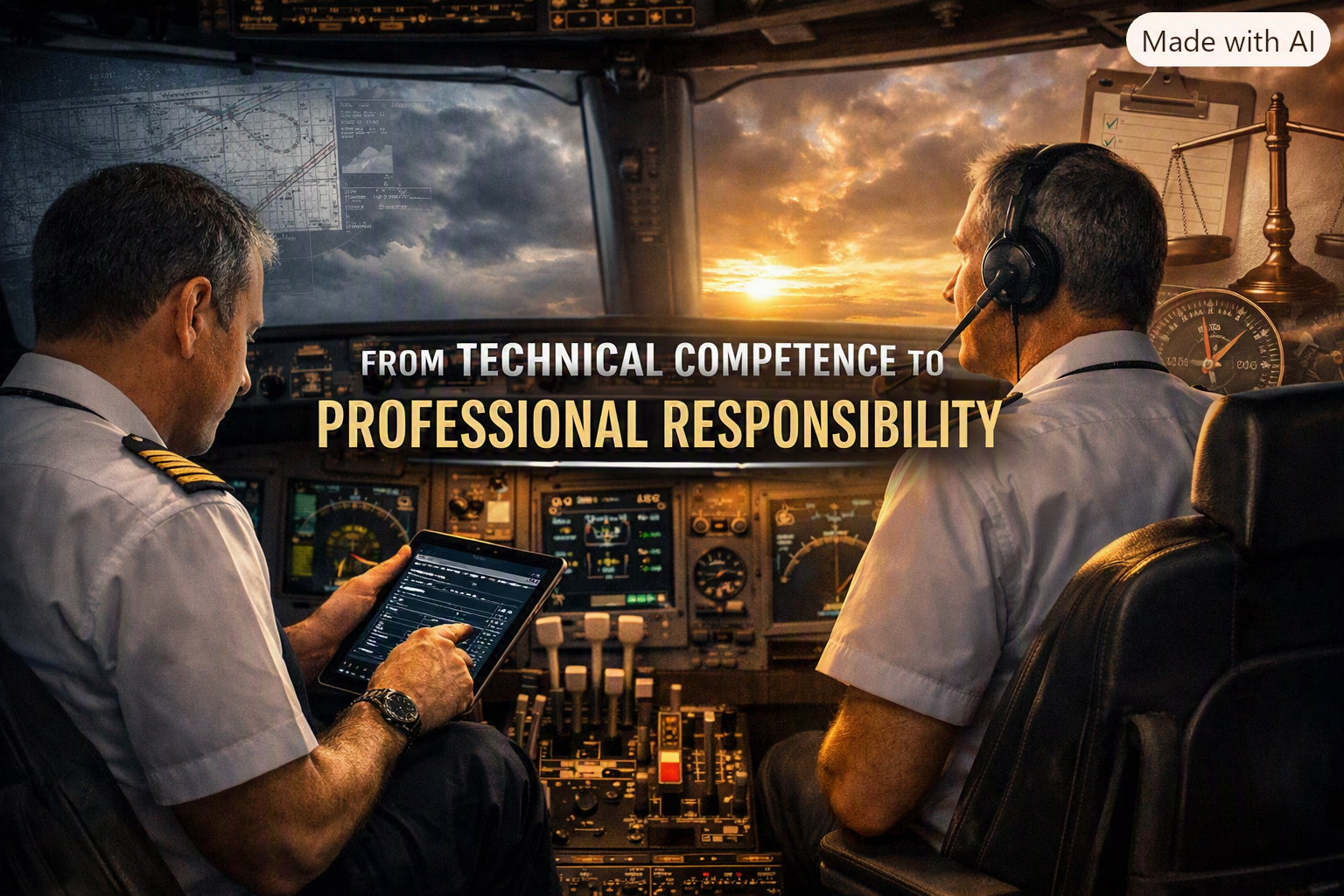
From Technical Competence to Professional Responsibility
Technical competence earns a person a place in aviation. Professional responsibility determines how far that person can go.
Every aviation career begins with learning how to perform specific tasks correctly. Pilots master aircraft systems and procedures. Maintenance technicians develop the ability to inspect, troubleshoot, and repair aircraft. Dispatchers learn to evaluate weather, performance, routing, and operational risk. Flight attendants, air traffic controllers, ground personnel, safety specialists, and managers each develop a specialized body of knowledge.
These technical abilities are essential. However, aviation career advancement eventually requires more than performing assigned duties well. As professionals gain experience, employers expect them to exercise judgment, communicate effectively, support others, protect organizational standards, and accept responsibility for outcomes beyond their individual work.
Technical Skill Establishes Credibility
Early in a career, credibility is built through preparation, reliability, and attention to detail. A professional arrives ready to work, follows established procedures, asks appropriate questions, and completes assignments accurately. When uncertain, that person seeks clarification instead of guessing. When a mistake occurs, it is reported honestly and corrected.
Competence, however, is not the final destination. A technically skilled employee who cannot communicate, accept feedback, or consider the broader operation may eventually reach a career plateau.
Responsibility Expands With Experience
As aviation professionals advance, the scope of their responsibility changes. They are no longer evaluated only on whether they completed a task correctly. They are also judged by how their decisions affect the team, the customer, the aircraft, the schedule, and the safety of the operation.
A senior technician may be expected to mentor a new employee. An experienced dispatcher may help coordinate a complex recovery plan. A captain must create an environment in which crewmembers can raise concerns. A supervisor may need to balance operational demands with staffing limitations and regulatory requirements.
In each case, professional responsibility means looking beyond personal performance. It requires understanding how one decision can influence several other people or departments.
This broader perspective is central to aviation career advancement. Organizations promote people who can protect the operation, not simply complete their own portion of it.
Judgment Becomes More Important
Technical training often presents clear standards and correct procedures. Professional life introduces situations in which information is incomplete, priorities compete, and several choices may appear reasonable.
Sound judgment involves recognizing risk, gathering relevant information, consulting the right people, and selecting a defensible course of action. It also requires knowing when to pause, when to escalate a concern, and when conditions no longer support the original plan.
Experienced professionals are not expected to know everything. They are expected to recognize the limits of their knowledge and use available resources intelligently. Asking for assistance is not a weakness when the situation requires additional expertise. Pretending to understand something can create unnecessary risk.
Good judgment also includes resisting pressure. Aviation employees may face demands from passengers, customers, managers, coworkers, or schedules. A professional must distinguish between a legitimate operational priority and pressure that encourages the erosion of standards.
Aviation Career Advancement: Communication Is a Career Skill
Many capable employees underestimate the role of communication in aviation career advancement. They assume their work should speak for itself. Strong performance matters, but advancement often depends on the ability to explain, coordinate, listen, and influence.
Professional communication is clear, timely, and appropriate to the situation. It provides others with the information they need without creating confusion or unnecessary conflict. It also includes listening carefully and confirming that important information has been understood.
Communication becomes especially important when raising a safety concern or disagreeing with a decision. Vague objections are easy to dismiss. A stronger approach identifies the condition, explains the operational consequence, and recommends an alternative.
Reliability Builds Professional Trust
Trust develops when words and actions remain consistent. Reliable professionals meet commitments, communicate delays early, protect confidential information, and follow through without repeated reminders. They do not disappear when a task becomes difficult or blame others when results are disappointing.
Accountability is particularly important. Responsible professionals acknowledge their contribution to a problem and participate in correcting it. They focus on what can be learned rather than protecting their image.
Leadership Begins Before the Title
An employee demonstrates leadership by assisting a new coworker, sharing useful information, remaining calm during disruption, or respectfully challenging an unsafe assumption. These actions show that the person is prepared to contribute beyond the minimum requirements of the job.
Aspiring leaders should avoid confusing leadership with authority. Authority may come with a title, but leadership is earned through competence, judgment, consistency, and service to others.
Prepare Deliberately for Advancement
Aviation career advancement should not be left entirely to chance. Professionals can prepare by studying the requirements of the next position and identifying gaps in their experience.
Ask what successful people in that role know, what decisions they make, and which relationships they must manage. Seek assignments that develop those capabilities. Request meaningful feedback from supervisors, mentors, and trusted colleagues. Pursue additional training when it addresses a genuine developmental need, not merely another line on a résumé.
Keep a record of accomplishments, new responsibilities, safety contributions, projects, and measurable results. This information can support performance reviews, interviews, and promotion discussions. More importantly, it reveals whether your current efforts are actually moving you toward your objective.
Aviation Career Advancement: The Professional You Become
Aviation career advancement is not simply movement toward higher pay or a more impressive title. It is the gradual expansion of trust, influence, and responsibility.
Technical competence will open the first doors. To continue advancing, you must demonstrate that you can make sound decisions, communicate clearly, support the people around you, and protect standards when doing so is inconvenient.
The most valuable aviation professionals understand that their work is connected to something larger than themselves. They do not ask only, “Did I complete my task?” They also ask, “Did my actions strengthen the operation?”
That change in perspective marks the transition from a capable employee to a truly trusted professional. It is also the foundation for a meaningful, sustainable aviation career.