
The easiest technical assessment to create is usually a list of questions someone already has on file. It may cover regulations, terminology, aircraft systems, or general industry knowledge. It may even look professional.
That does not mean it measures the right things.
Useful aviation technical assessments begin with the work, not the test. Before writing questions, an employer must understand what the person in the position will be expected to do, which decisions the person will be authorized to make, and what could happen if those responsibilities are handled poorly.
A generic assessment may identify people who are good at taking tests. A role-specific assessment is more likely to identify people who can perform the job.
Begin With the Actual Assignment
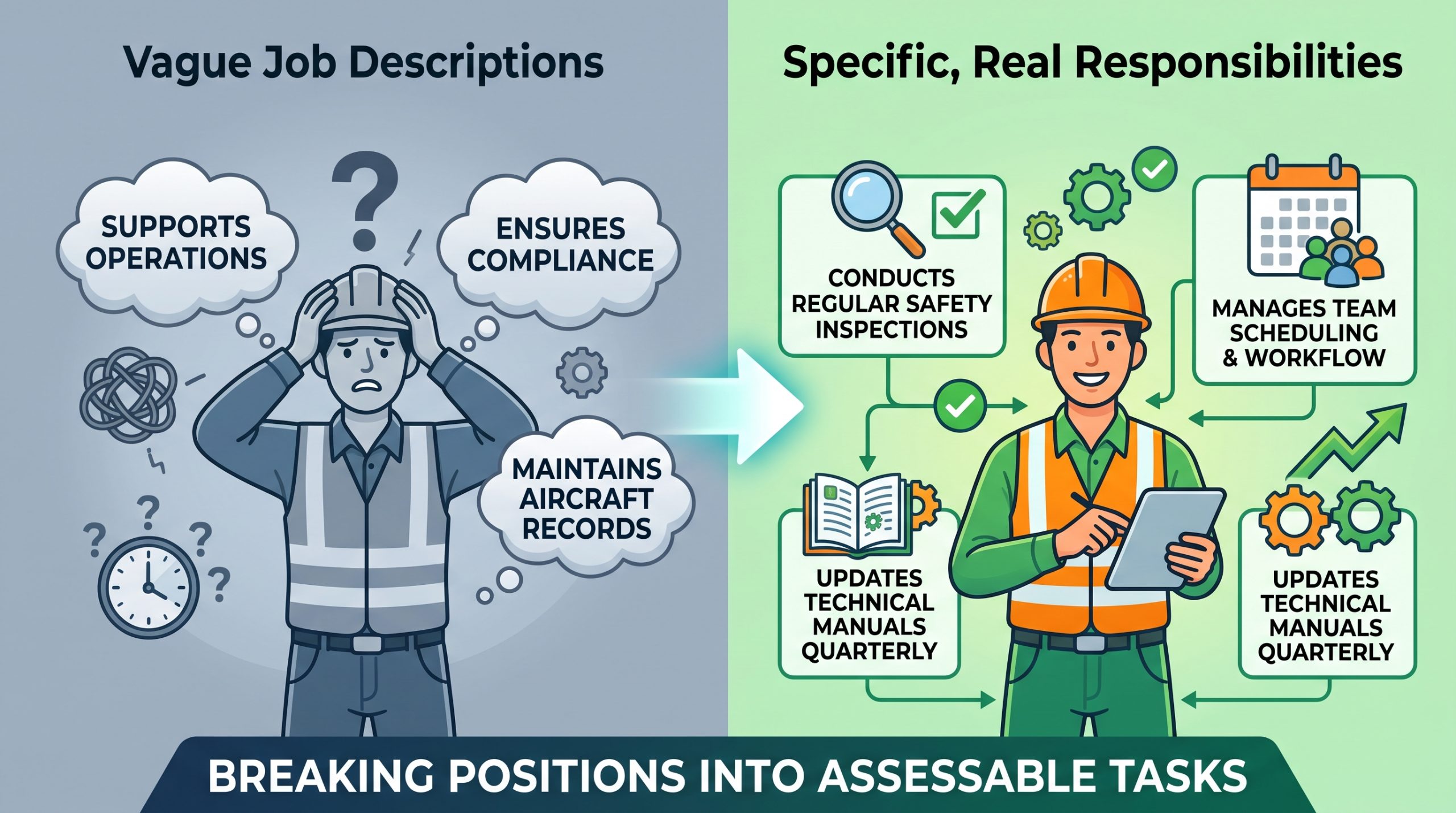
Job descriptions often contain broad phrases such as “supports operations,” “ensures compliance,” or “maintains aircraft records.” Those statements may be accurate, but they are not specific enough to guide an assessment.
The employer should break the position into real responsibilities.
What information does the employee receive? What must be reviewed or verified? Which decisions can be made independently? When is approval required? Which departments depend on the employee’s work? What must be documented?
For a maintenance controller, this might include evaluating reported discrepancies, coordinating troubleshooting, reviewing deferral options, and communicating aircraft status. For a crew scheduler, the work may involve tracking qualifications, identifying coverage problems, applying company rules, and escalating potential conflicts.
The assessment should reflect those responsibilities. If a task is not part of the job and does not help predict success, there is little reason to test it.
Separate Essential Knowledge From Trainable Knowledge
Not every knowledge gap should carry the same weight.
Some information must be understood before the employee can safely perform the job. Other knowledge can reasonably be taught during onboarding, equipment training, or familiarization with company procedures.
Employers designing aviation technical assessments should divide the required knowledge into three general categories:
- Knowledge the candidate must bring to the position
- Knowledge that can be learned during normal training
- Knowledge that is helpful but not essential
This prevents an employer from rejecting a strong candidate simply because that person has not used the company’s software, terminology, or internal forms.
It also helps distinguish between experience and readiness. A candidate may never have used a particular maintenance-tracking platform, but extensive experience with similar systems may demonstrate the ability to learn it quickly. The relevant skill is not always knowledge of one product. It may be the ability to interpret records accurately and maintain control of time-sensitive requirements.
Identify the Decisions That Matter
Technical work in aviation is rarely limited to completing isolated tasks. Employees must decide what requires immediate attention, what can wait, and what information must be passed to someone else.
Those decision points should become part of the assessment.
For example, a scenario for an airport operations candidate could involve a reported airfield condition, incomplete information, and competing operational demands. A scenario for a safety investigator might include several witness accounts that do not fully agree. A maintenance planning candidate could be given upcoming inspections, limited downtime, and a change in aircraft utilization.
The employer is not merely looking for one predetermined answer. The evaluator should observe whether the candidate:
- Recognizes the main risk
- Identifies missing information
- Establishes reasonable priorities
- Consults the appropriate resources
- Works within the limits of the position
- Communicates the decision clearly
- Documents or escalates the matter when required
Well-designed aviation technical assessments reveal the candidate’s working process instead of measuring memory alone.
Match the Format to the Responsibility
Different abilities require different assessment methods.
Use Written Questions for Foundational Knowledge for Aviation Technical Assessments
Written questions work well when there are clear answers involving regulations, terminology, limitations, or established procedures. They can confirm that candidates possess the baseline knowledge expected for the role.
Questions should be current, clearly worded, and relevant. Obscure details rarely predict job performance unless recalling those details is genuinely important to the work.
Use Scenarios for Judgment
Scenarios are useful when the job requires prioritization, coordination, or decisions under changing conditions.
A good scenario should resemble a problem the employee may actually encounter. It should include enough complexity to require thought without becoming a guessing game.
The strongest candidates often ask questions before giving an answer. The assessment should leave room for that behavior.
Use Work Samples for Applied Ability
A work sample asks the candidate to complete a representative task. This might include reviewing a logbook entry, preparing an operational briefing, analyzing a staffing problem, identifying errors in a record, or drafting a response to an internal safety concern.
Work samples can be among the most useful aviation technical assessments because they allow the employer to observe performance directly.
The exercise should still be limited in scope. Candidates should not be asked to produce extensive unpaid work or solve a major business problem as part of the hiring process.
Use Structured Discussion for Leadership Roles
Managers and senior professionals may not spend their days performing the same technical tasks as frontline employees. Their assessment should examine how they oversee those tasks, resolve competing priorities, allocate resources, and maintain standards.
A chief pilot, director of maintenance, safety manager, HR leader, airport manager, or operations executive may need to explain how they would investigate a recurring problem, respond to pressure from senior leadership, or manage disagreement between departments.
The technical element is still present. It is being evaluated through organizational responsibility rather than task execution alone.
Aviation Technical Assessments: Build Assessments for the Position, Not the Profession
Aviation employers sometimes test candidates against the broadest possible version of an occupation. That approach can produce misleading results.
An A&P mechanic working in a line-maintenance environment may need a different mix of skills from a technician assigned to heavy inspections or component repair. A corporate flight attendant may be evaluated differently from a crewmember working under an airline training program. A flight coordinator may handle customer communication, logistics, permits, and trip support without exercising the authority of a certificated aircraft dispatcher.
Role-specific aviation technical assessments must account for these differences.
The employer should consider:
- The regulatory environment
- The equipment or aircraft involved
- The complexity and tempo of the operation
- The employee’s level of authority
- Available supervision and support
- The consequences of an error
- The amount of training provided after hiring
The goal is not to make the assessment easier. It is to make it relevant.
Establish a Scoring Guide Before Evaluating Candidates
Evaluators should agree on what they are looking for before the first candidate begins.
A scoring guide can identify the essential elements of a satisfactory answer, common errors, and any response that should create a serious concern. It should also allow evaluators to recognize sound reasoning even when a candidate takes a different but defensible path.
For scenario questions, employers may score several components separately:
- Technical accuracy
- Risk recognition
- Use of available resources
- Quality of judgment
- Communication
- Compliance with authority limits
- Documentation or follow-up
This produces more useful information than a single pass-or-fail judgment.
It also reduces the influence of personality. A confident candidate should not automatically score higher than a quieter candidate whose reasoning is more accurate and disciplined.
Use Qualified Evaluators
The person administering the assessment should understand both the technical subject and the requirements of the position.
That does not mean every evaluator must hold the exact job being filled. It does mean the evaluation team should include someone capable of recognizing correct reasoning, unsafe assumptions, and meaningful gaps in knowledge.
Evaluators should also know how to conduct an assessment professionally. Interrupting candidates, turning questions into debates, or repeatedly trying to prove them wrong does not improve the hiring decision.
The evaluator represents the employer. The quality of the process tells candidates something about the quality of the organization.
Test the Assessment Before Using It
Before an assessment becomes part of the hiring process, ask a few qualified employees to complete it.
Their responses can reveal unclear wording, multiple reasonable answers, outdated material, unrealistic time limits, and questions that do not measure what the employer intended.
If experienced employees consistently interpret a question differently, the problem may be the question rather than the employees.
Employers should also review aviation technical assessments whenever the position, equipment, procedures, or regulatory environment changes. An assessment that was appropriate several years ago may no longer reflect the work.
Keep the Candidate Experience Professional
A difficult evaluation can still be a fair one.
Candidates should know what type of assessment they will complete, how long it is expected to take, and whether any preparation materials are appropriate. They do not need advance access to the questions, but they should understand the general subjects and format.
Instructions should be clear. Necessary tools and reference materials should be provided. Candidates should be given a reasonable opportunity to explain their thinking.
The process should leave a qualified candidate believing that the employer takes standards seriously—not that the organization enjoys catching people off guard.
Measure What the Employer Actually Needs
The best aviation technical assessments are not necessarily the longest or most difficult. They are the ones that help the employer make a better distinction among candidates.
A strong assessment shows who possesses the required foundation, who can apply knowledge to real problems, who understands the boundaries of the position, and who can grow through training. It also identifies candidates whose confidence exceeds their competence or whose decision-making could create unnecessary risk.
When the assessment is tied directly to the work, employers gain information that résumés and conventional interviews cannot provide. They are no longer asking only whether the candidate has worked in aviation.
They are determining whether that person is ready to perform this job, in this organization, with the responsibilities that come with it.