
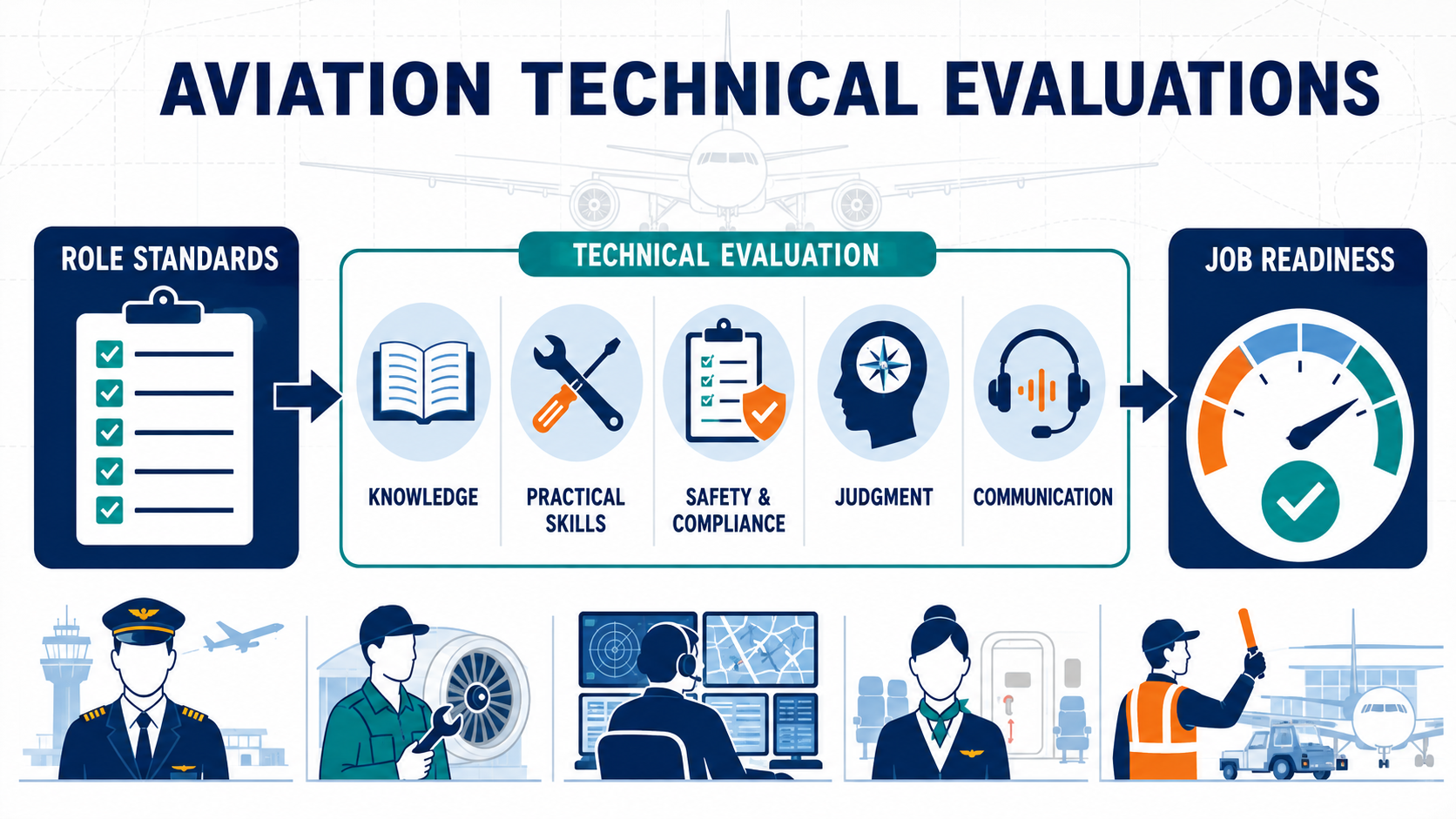
How Employers Measure Job Readiness
A résumé tells an employer what a candidate has done. An interview helps explain how that person thinks, communicates, and approaches responsibility. Neither one, however, fully answers the question that matters most during aviation hiring:
Can this person perform the work safely and effectively in our operation?
That is the purpose of aviation technical evaluations. They help employers look beyond certificates, job titles, and years of experience to determine whether a candidate can apply what they know to the actual demands of the position.
The word “technical” can be misleading. It may bring to mind a written test filled with regulations, aircraft systems, or maintenance questions. Those subjects may be important, but job readiness involves more than factual recall. A useful evaluation also considers judgment, situational awareness, communication, procedural discipline, and the ability to recognize when additional information or assistance is needed.
Technical Qualifications Do Not Automatically Establish Readiness
A candidate may meet every published qualification and still require considerable development before being ready for a particular assignment.
Certificates, ratings, licenses, and industry credentials establish important baselines. Previous employment demonstrates exposure and experience. None of those factors guarantees that a person can immediately perform within a new employer’s aircraft, equipment, procedures, technology, or operational environment.
A technician may hold the required certificate but have limited experience with the aircraft type being maintained. A dispatcher may understand regulatory requirements but be unfamiliar with the employer’s route structure and operational tempo. A safety professional may know the language of safety management yet struggle to turn reports and data into practical corrective action.
Effective aviation technical evaluations identify the distance between a candidate’s existing ability and the level of performance the employer needs.
That distance is not always a reason to reject someone. It may simply reveal the amount and type of training required. Employers can then make a more informed decision about whether the candidate can become fully qualified within an acceptable period.
What Employers Are Trying to Measure
A well-built technical evaluation usually examines several dimensions of readiness.
Working Knowledge
Does the candidate understand the regulations, procedures, systems, equipment, or processes that are central to the job?
The questions should reflect the responsibilities of the position. A maintenance planner should not receive the same evaluation as an A&P technician. A flight coordinator should not be tested as though the position requires an aircraft dispatcher certificate when it does not.
Practical Application
Knowing an answer and using that knowledge correctly are different abilities.
A candidate may be able to describe a procedure during an interview but have difficulty applying it when information is incomplete or conditions begin to change. Scenario-based questions allow the employer to see how the person organizes information, identifies priorities, and moves toward a defensible decision.
Judgment
Aviation work routinely requires people to make decisions within limits. Strong candidates recognize those limits.
An employer should pay attention to whether the candidate knows when to stop, verify, escalate, or ask for help. A person who confidently guesses may present more risk than someone who says, “I would need to confirm that before proceeding.”
That answer is not necessarily a sign of weakness. In many aviation jobs, it reflects professional discipline.
Communication
Technical ability loses value when a person cannot communicate important information clearly.
Maintenance discrepancies, operational restrictions, scheduling conflicts, safety concerns, and personnel issues frequently cross departmental lines. Aviation technical evaluations should therefore consider how candidates explain a problem, document a decision, and communicate with people who may not share their technical background.
Procedural Discipline
Employers also need to know how candidates respond to established procedures.
Do they treat procedures as operational tools, or as obstacles to work around? Can they explain why a step matters? Do they understand the difference between using professional judgment and disregarding a requirement?
These questions often reveal more about future job performance than a long series of trivia questions.
Common Evaluation Formats
There is no single format that works for every aviation position. Employers should choose the method that most closely resembles the work being evaluated.
Technical Interviews
A structured technical interview allows the employer to explore the candidate’s knowledge and reasoning. Every candidate should receive the same core questions, although follow-up questions may be used to clarify an answer.
The evaluator should be listening for more than the correct conclusion. How the candidate reached that conclusion may be equally important.
Written Assessments
Written tests can efficiently measure baseline knowledge, especially when the position has clear regulatory, procedural, or equipment-related requirements.
They are less effective when used alone. Some candidates test well but struggle to apply their knowledge. Others may understand the work but perform poorly on questions that are vague, outdated, or unrelated to the actual assignment.
Aviation Technical Evaluations: Scenario-Based Evaluations
Scenarios are particularly useful for operational, supervisory, safety, dispatch, maintenance-control, and management positions.
A strong scenario gives the candidate enough information to begin but still requires questions, prioritization, and judgment. The goal is not to create a trick question. It is to observe how the candidate works through a realistic problem.
Practical Demonstrations
Some roles are best evaluated through direct performance. This might involve troubleshooting a simulated discrepancy, reviewing a maintenance record, building a flight release, inspecting documentation, using a software platform, conducting a briefing, or responding to a mock operational event.
Practical aviation technical evaluations should take place under controlled conditions with clear expectations and consistent scoring.
Job Readiness Is Specific to the Employer
A person can be highly competent and still be unprepared for a particular operation.
A small corporate flight department, a large airline, an airport authority, an MRO, a charter operator, and an aerospace manufacturer may all define readiness differently. The pace of work, available resources, reporting relationships, technology, and level of individual authority can vary considerably.
Consider two candidates for an aviation management position. One may have worked in a large organization with specialized departments and extensive support. The other may come from a smaller operation where managers handle budgets, staffing, vendor oversight, compliance, and daily operational problems personally.
Both may be capable professionals. The relevant question is which background and working style best fit the position being filled.
This is why generic testing has limited value. Aviation technical evaluations should be connected to the employer’s real operating environment rather than an abstract description of the profession.
Consistency Makes the Evaluation More Useful
Technical evaluations should not become informal contests in which each interviewer asks whatever comes to mind.
Employers should identify the core competencies before interviews begin, develop common questions or exercises, and establish what acceptable performance looks like. Evaluators should document what they observed rather than relying on general impressions.
A scoring guide does not need to be complicated. It should distinguish among answers that are:
- Technically correct and complete
- Generally correct but missing an important consideration
- Partially correct and requiring substantial guidance
- Incorrect or potentially unsafe
- Unsupported by enough information to evaluate
The scoring system should also recognize good judgment. If a scenario intentionally lacks critical information, a candidate who identifies the missing information may be demonstrating exactly what the employer needs.
Consistency does not eliminate professional judgment. It gives that judgment a dependable structure.
Aviation Technical Evaluations: What Candidates Should Expect
Candidates preparing for aviation technical evaluations should begin with the position itself.
Review the job description, employer type, equipment, operating environment, and stated responsibilities. Refresh the regulations and technical material that directly affect the role. Be prepared to explain how you have handled comparable situations, including occasions when you had to slow down, obtain additional information, or involve another department.
During the evaluation, do not rush to fill silence. Ask clarifying questions when necessary. State any assumptions you are making. If you do not know something, explain how you would find the correct answer before taking action.
Experienced evaluators can usually distinguish between a temporary gap in knowledge and a pattern of careless reasoning. Trying to bluff through an answer can turn a manageable knowledge gap into a serious credibility problem.
The Evaluation Should Support a Better Hiring Decision
The purpose of a technical assessment is not to prove that the evaluator knows more than the candidate. It is not an opportunity to use obscure questions to establish authority. It is a hiring tool.
The best aviation technical evaluations help employers understand what a candidate can do now, where training will be required, and how that person is likely to respond when the work becomes complicated. They also give qualified candidates an opportunity to demonstrate abilities that may not be obvious from a résumé.
Aviation employers will rarely eliminate every uncertainty from a hiring decision. They can, however, ask better questions, use more relevant exercises, and evaluate the qualities that actually affect performance.
When the process is built around the realities of the job, a technical evaluation becomes more than a test. It becomes a practical measure of whether the candidate is ready to assume responsibility within the operation.