
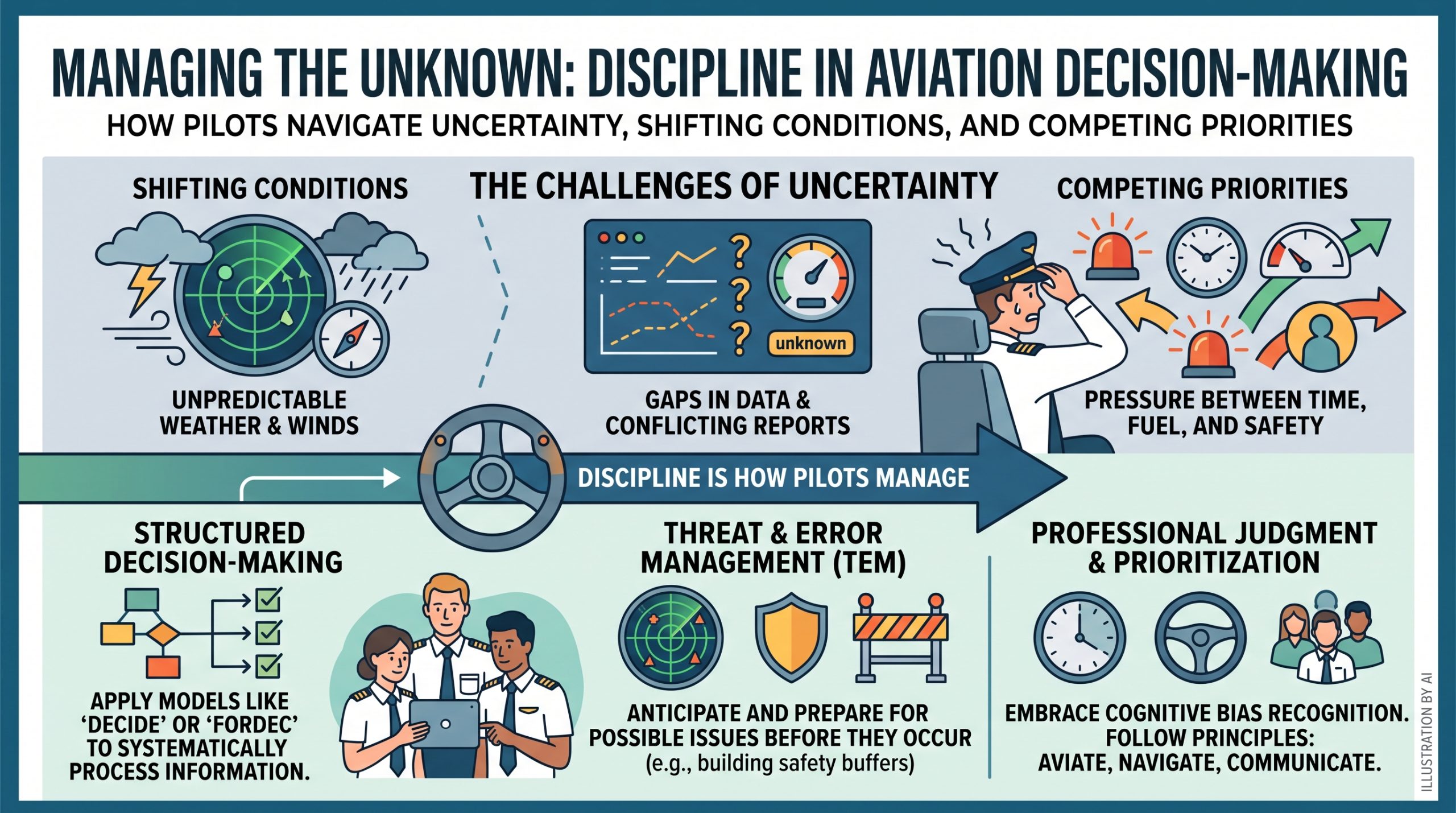
Developing Sound Judgment as an Aviation Professional
Aviation professionals work in an environment where conditions change, information may be incomplete, and choices can produce consequences. Whether you are a pilot, aircraft mechanic, dispatcher, flight attendant, air traffic controller, ground operations specialist, or manager, your ability to exercise sound judgment affects safety, efficiency, and professional credibility.
Good judgment is not an instinct that some people possess and others do not. It is a professional capability developed through preparation, experience, reflection, and disciplined aviation decision-making. Technical knowledge provides the foundation, but judgment determines how that knowledge is applied when the correct response is not immediately obvious.
What Is Aviation Decision Making?
Aviation decision-making is the process of identifying a situation, evaluating the available information, considering possible courses of action, and selecting an appropriate response. It combines technical competence with situational awareness, risk assessment, communication, and personal discipline.
The strongest aviation professionals do not wait for an emergency to begin thinking. They continually consider what is happening, what might happen next, and what they will do if conditions deteriorate.
Sound Judgment Begins Before the Decision
Poor decisions often begin before a choice becomes unavoidable. They may originate with incomplete preparation, unclear responsibilities, weak communication, or a failure to establish limits in advance.
Preparation creates the foundation for sound judgment. Professionals who understand their duties, know the applicable procedures, and anticipate likely threats are better positioned to respond when circumstances change.
Before beginning a task or operation, ask:
- What are the most likely threats?
- Which conditions would require us to stop or change the plan?
- What information is missing?
- Who has the authority to make the decision?
- What alternatives are available?
- How much time remains before our options narrow?
These questions turn decision-making from a reaction into a deliberate process. They also reduce the influence of stress, urgency, and organizational pressure when conditions become difficult.
Recognize What Can Distort Judgment
Aviation professionals rarely make poor decisions because they want an unsafe outcome. More often, judgment is distorted by pressures that are not immediately recognized.
Schedule pressure is a common example. A delayed departure, demanding customer, maintenance deadline, or disrupted schedule can create a powerful desire to keep the operation moving. That desire may gradually become more important than an objective assessment of risk.
Other influences include fatigue, overconfidence, incomplete information, fear of disappointing others, and reluctance to challenge someone with greater seniority. Confirmation bias can cause people to favor information supporting the original plan while minimizing evidence that a change is necessary.
Slow the Situation Down
When pressure increases, people naturally tend to act quickly. Some situations require immediate action, but many allow more time than they initially appear to.
A brief pause can improve judgment significantly. Clarify the problem. Separate known facts from assumptions. Consult the appropriate checklist, manual, weather source, technical reference, or qualified colleague. When possible, identify more than one acceptable course of action.
A practical decision sequence is:
- Identify what has changed.
- Determine the immediate risk.
- Gather the most relevant information.
- Develop realistic alternatives.
- Select and communicate a course of action.
- Monitor the results and revise the plan when necessary.
Use Procedures Without Surrendering Judgment
Regulations, policies, checklists, and standard operating procedures are essential safeguards. They preserve lessons learned across decades of aviation experience and provide consistency when workloads are high.
Procedural compliance and professional judgment are not competing ideas. Procedures establish boundaries and guide action. Judgment helps a professional recognize which procedure applies, when additional caution is warranted, and when a situation should be elevated to someone with greater authority.
A procedure should never be ignored merely because it is inconvenient. At the same time, following a checklist mechanically without understanding the surrounding conditions can create a false sense of security. Competent professionals understand both what the procedure requires and why it exists.
Develop the Courage to Speak Up
Sound judgment has little value if a person is unwilling to communicate a concern. Aviation depends on professionals who can question unsafe assumptions, identify emerging threats, and recommend safer alternatives.
Effective communication should address the operational risk.
Instead of expressing a vague objection, explain what you observe and why it matters. Clear language makes a concern harder to misunderstand or dismiss.
If the risk remains unresolved, use the appropriate reporting or escalation process. Professionalism does not require silence. In many situations, it requires respectful persistence.
Learn Deliberately From Experience to Enhance Your Aviation Decision Making
Experience strengthens judgment only when it is examined honestly. Repetition alone does not guarantee improvement. Someone can repeat the same weak decision process for years and simply become more confident in it.
After a demanding operation or difficult decision, ask what information you noticed early, what you overlooked, which assumptions proved incorrect, and whether outside pressure influenced your response. Consider whether you communicated clearly and what you would do differently next time.
Debriefing should not be reserved for accidents or major incidents. Routine reflection helps professionals recognize patterns before those patterns contribute to a serious event. Safety reports, case studies, incident reviews, mentoring, and recurrent training also provide lessons that would be costly or dangerous to learn firsthand.
Judgment Defines Your Professional Reputation
Employers value technical competence, but technical skill alone does not define a trusted aviation professional. Organizations need people who remain composed, communicate honestly, follow established standards, recognize their limitations, and make thoughtful decisions when the answer is uncertain.
Your reputation is built in ordinary moments: reporting a concern that would be easier to ignore, asking for help before becoming overwhelmed, or changing a plan when the evidence no longer supports it.
Sound aviation decision-making is not about eliminating uncertainty. Aviation will always involve changing conditions, incomplete information, and competing priorities. The goal is to manage uncertainty with discipline.
Learn the standards. Prepare before acting. Recognize pressure. Invite input. Communicate concerns clearly. Review your decisions honestly. Over time, these habits become judgment, and judgment becomes one of the most valuable qualifications an aviation professional can possess.